Few American muscle cars command the same respect, fascination, and collector enthusiasm as the 1969 Ford Mustang Boss 429. With its enormous racing-inspired V8 engine, aggressive fastback styling, limited production numbers, and unusual connection to NASCAR, this Mustang occupies a special place in automotive history.
At first glance, it might look like another beautifully restored late-1960s Mustang. But beneath that unmistakable long hood lies one of the most extraordinary engineering stories Ford ever brought to the street.
The Boss 429 wasn’t simply built to impress buyers at stoplights. It was created to help Ford compete at the highest levels of American stock-car racing. To make that happen, Ford had to transform its popular Mustang into something it had never been designed to accommodate.
The result was a rare, expensive, and remarkably ambitious muscle car that remains a dream acquisition for serious collectors.
Here are 26 fascinating things about the 1969 Ford Mustang Boss 429 that explain why enthusiasts often call it the Holy Grail of Mustangs.
1. The Boss 429 Was Built Because of NASCAR
The most important fact about the Boss 429 is that its existence was driven by racing rather than ordinary showroom demand.
During the late 1960s, Ford was determined to challenge Chrysler’s formidable Hemi-powered NASCAR competitors.
Ford developed a new 429-cubic-inch V8 engine featuring hemispherical-style combustion chambers and enormous breathing potential.
To qualify the engine for NASCAR competition under the period’s homologation requirements, Ford needed to make it available in a production automobile.
The Mustang Boss 429 became that car.
Interestingly, the engine’s principal racing application was in Ford’s larger NASCAR stock cars, not the Mustang itself.
That unusual connection makes the Boss 429 one of the most fascinating homologation specials of the muscle-car era.
2. Only 859 Production Examples Were Built for 1969
Rarity is one of the biggest reasons the 1969 Boss 429 is so desirable.
Ford produced just 859 regular-production Boss 429 Mustangs for the 1969 model year, commonly identified by their distinctive KK-series serial numbers.
That is an exceptionally small number compared with ordinary Mustangs of the period.
Not every surviving example remains original, and many have undergone restoration or mechanical modifications over the decades.
Collectors therefore place enormous importance on documentation, original components, and accurate factory specifications.
Finding a genuine 1969 Boss 429 is difficult.
Finding one with outstanding provenance is considerably harder.
3. Its 429-Cubic-Inch V8 Was Unlike Ordinary Mustang Engines
The Boss 429’s engine displaced 429 cubic inches, approximately 7.0 litres.
That made it one of the largest and most ambitious engines fitted to a factory Mustang of its era.
But displacement alone does not explain what made it special.
Its architecture featured enormous cylinder heads, large valves, and combustion-chamber design developed with high-performance racing in mind.
The engine was intended to breathe efficiently at high speeds while supporting Ford’s racing objectives.
Compared with more conventional street-oriented V8 engines, the Boss 429 represented a very different engineering philosophy.
It was a race-bred powerplant adapted for road use rather than a typical passenger-car engine modified for extra performance.
4. Ford Officially Rated It at 375 Horsepower
Despite its extraordinary engineering, Ford advertised the Boss 429 at 375 horsepower.
That number has fascinated enthusiasts for decades.
The published rating placed it alongside other powerful muscle cars, but the engine’s sophisticated cylinder heads and racing background suggested substantial performance potential.
Some enthusiasts believe the rating understated its capabilities.
However, the stock road-going Boss 429 was not automatically the quickest Mustang in every acceleration test.
Its street tune, substantial weight, gearing, and engine characteristics affected real-world results.
The real distinction was not simply the advertised horsepower.
It was the engineering potential of the engine and its connection to Ford’s racing programme.
5. The Engine Was So Large That the Mustang Needed Major Surgery
The standard 1969 Mustang engine compartment was not designed around the Boss 429’s enormous cylinder heads.
Ford engineers faced a serious packaging problem.
The engine simply could not be installed in a conventional Mustang engine bay without significant changes.
The solution required extensive modifications to the front structure and suspension layout.
This was far more involved than swapping a larger engine into an ordinary Mustang.
It turned the Boss 429 into one of the most heavily re-engineered factory Mustangs of its generation.
That complexity is a major part of the car’s appeal today.
6. Kar Kraft Played a Crucial Role in Building It
The Boss 429 was not completed through an entirely ordinary Mustang assembly process.
Ford relied on Kar Kraft, a specialist engineering company in Brighton, Michigan, to carry out the extensive modifications required.
Mustang SportsRoof bodies were prepared by Ford and then sent to Kar Kraft for the specialised conversion work.
Kar Kraft modified the engine compartment, installed the massive powerplant, and completed other necessary engineering changes.
This unusual production arrangement gave the Boss 429 a distinctive identity.
It was a Ford production car, but one with an unusually close connection to specialist racing and engineering expertise.
7. The Shock Towers Had to Be Modified
One of the most distinctive engineering changes involved the front shock towers.
On an ordinary Mustang, the shock towers occupied valuable space around the engine.
The Boss 429’s cylinder heads were too wide to fit comfortably between them.
Kar Kraft modified the front suspension structure to create additional clearance.
These changes are among the important details specialists examine when authenticating a Boss 429.
They also help explain why converting a normal Mustang into a convincing Boss 429 replica is considerably more complicated than adding badges and a hood scoop.
The real car’s differences extend deep into its structure.
8. It Used a Special Front Suspension Arrangement
Accommodating the Boss 429 required more than simply creating additional engine clearance.
The front suspension geometry and mounting arrangements also needed attention.
The Boss 429 received specialised components and engineering changes designed to work with its modified engine bay.
These details distinguish it from more ordinary performance Mustangs.
They also illustrate the extent to which Ford was willing to modify an existing platform to satisfy its racing objectives.
The Boss 429 was not just a Mustang with a giant engine.
It was an integrated engineering project.
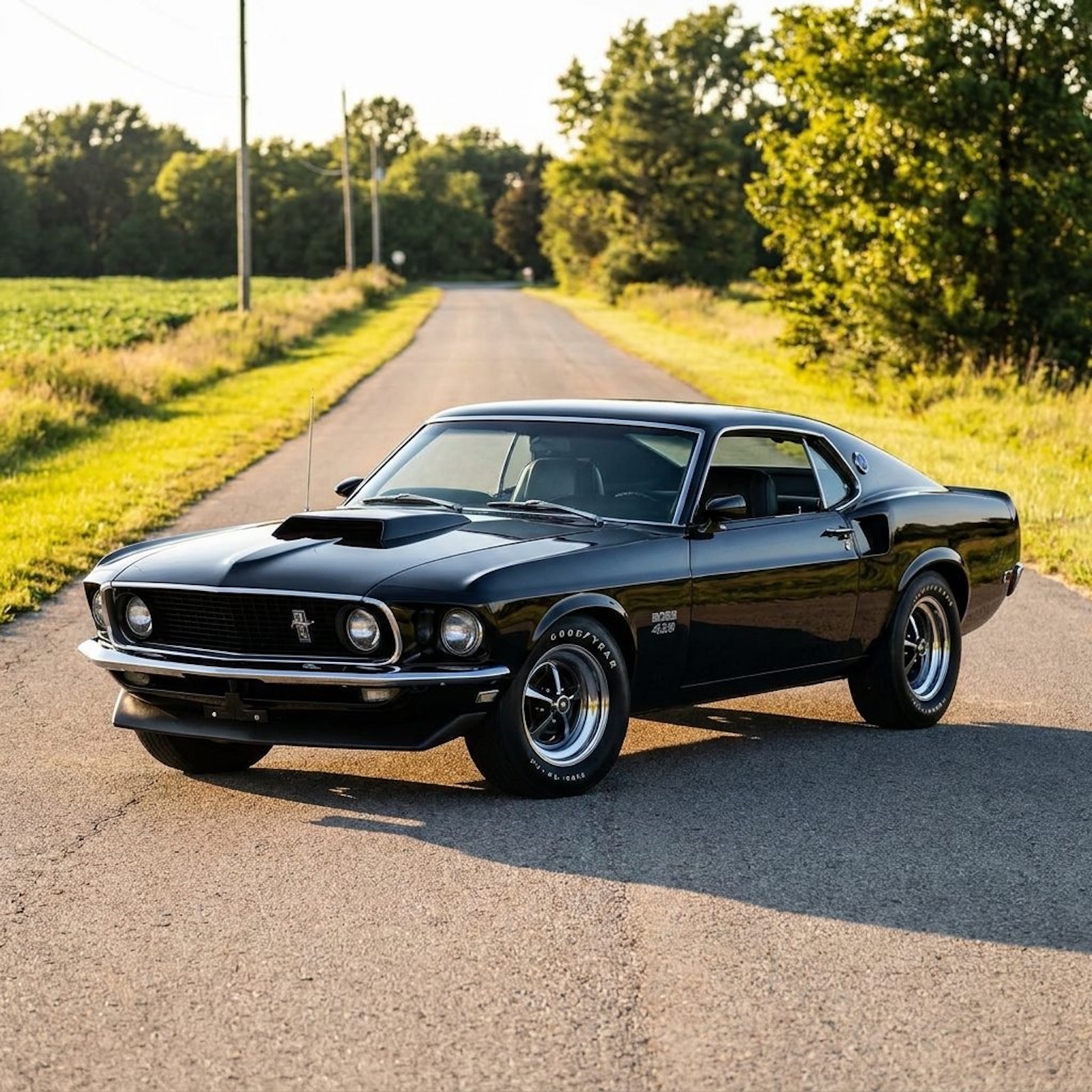
9. Its Huge Hood Scoop Became a Signature Feature
One of the easiest ways to recognise a 1969 Boss 429 is its prominent hood scoop.
The scoop helped provide clearance and an air-induction arrangement appropriate for the massive engine underneath.
Visually, it transformed the Mustang’s appearance.
The long hood already gave the 1969 SportsRoof an aggressive stance, but the Boss 429 scoop made it look even more purposeful.
Unlike some muscle cars covered in stripes and decorative details, the Boss 429 relied on a relatively restrained exterior.
That enormous scoop was enough to tell knowledgeable enthusiasts that this was no ordinary Mustang.
10. The 1969 SportsRoof Body Was the Perfect Starting Point
The 1969 Mustang SportsRoof is remembered for its dramatic fastback-inspired profile.
Its sweeping roofline, long hood, muscular rear quarters, and low stance made it one of the most recognisable Mustang designs ever produced.
The Boss 429 used this body style to tremendous effect.
The exterior combined understated performance styling with proportions that suggested serious speed.
Its appearance was less flamboyant than some contemporary muscle cars.
But that restraint gave it a sophisticated character.
For many collectors, the 1969 SportsRoof is one of the most attractive Mustang shapes ever created.
11. It Was Available in a Limited Selection of Colours
The 1969 Boss 429 was offered in a restricted range of factory exterior colours.
Commonly documented options include Raven Black, Wimbledon White, Black Jade, Candyapple Red, and Royal Maroon.
Each colour gives the car a different personality.
Raven Black emphasises its menacing appearance.
Wimbledon White highlights the muscular body lines.
Candyapple Red delivers a more traditional late-1960s muscle-car look.
Black Jade offers a distinctive dark green appearance that can look almost black under certain lighting.
Original factory paint specifications remain important to collectors evaluating authenticity.
12. The Exterior Was Surprisingly Understated
Considering the Boss 429’s extraordinary mechanical specifications, its exterior styling was relatively subtle.
The car did not rely on enormous side graphics or dramatic racing stripes to establish its identity.
Its hood scoop, Boss 429 identification, wheels, and muscular SportsRoof shape provided the visual clues.
That understated appearance is part of its enduring charm.
To an unfamiliar observer, it might resemble a well-equipped late-1960s Mustang.
To an enthusiast, however, the details reveal something far more special.
It is a muscle car that rewards knowledge rather than demanding attention.
13. It Came With a Four-Speed Manual Transmission
The Boss 429 was equipped with a heavy-duty four-speed manual transmission.
There was no ordinary automatic-transmission alternative in the factory Boss 429 specification.
The manual gearbox suited the car’s high-performance character and gave drivers direct control over the massive V8.
Driving one required a more involved approach than operating a modern performance car.
The clutch, gearshift, engine response, and mechanical noises all contributed to the experience.
For enthusiasts who value old-fashioned muscle-car involvement, that mechanical character is part of the attraction.
14. Its Rear Axle Was Designed for Serious Power
The Boss 429 needed a strong drivetrain to handle its substantial engine output.
Ford equipped the car with a heavy-duty rear axle arrangement appropriate for its performance requirements.
The Ford 9-inch rear axle was already well regarded for durability and strength.
In the Boss 429, the drivetrain was part of a package designed to withstand the demands of a powerful big-block V8.
Today, original axle identification and correct drivetrain components are important during restoration and authentication.
Collectors often pay close attention to these mechanical details because replacement parts can affect originality.
15. It Was Not the Same Car as the Boss 302
Although the Boss 302 and Boss 429 shared the Boss name, they were created for different racing objectives.
The Boss 302 was developed in connection with Trans-Am road racing and featured a high-revving small-block V8.
The Boss 429 was developed to homologate Ford’s large-displacement engine for NASCAR competition.
Their characters were therefore very different.
The Boss 302 emphasised a more balanced, road-racing-oriented package.
The Boss 429 was built around an enormous racing-inspired powerplant.
Both became legends, but for entirely different reasons.
16. The Engine’s Cylinder Heads Were Engineering Masterpieces
The Boss 429’s cylinder heads are among its most significant mechanical features.
Their design incorporated large valves and combustion chambers intended to support excellent airflow.
The engine was associated with Ford’s semi-hemispherical combustion-chamber concept, often described by enthusiasts as a Hemi-style design.
These heads were substantially different from those used on ordinary Ford big-block engines.
They helped create the engine’s remarkable high-performance potential.
They also contributed to its size, complexity, and production cost.
For many technically minded collectors, the cylinder-head design is the single most interesting feature of the entire car.
17. Its Engine Had Enormous Racing Potential
The street-going Boss 429 and the racing versions of Ford’s 429 engine were not identical in specification.
Nevertheless, the underlying engineering was developed with serious motorsport ambitions.
Race-prepared versions could produce considerably more power than the factory street rating.
That potential helped establish the Boss 429’s reputation among engine builders and racing enthusiasts.
The important distinction is that the production Mustang was designed to make the engine eligible for competition.
It was not delivered as a fully developed NASCAR race car.
That difference explains why its historical significance is greater than its original showroom acceleration figures might suggest.
18. It Was Extremely Expensive for a Mustang
The Boss 429 was one of the most expensive Mustangs available in 1969.
Its specialised engine, extensive engineering modifications, and limited production contributed to its high price.
A Boss 429 could cost well over $4,000 when new, depending on equipment and destination charges.
That was serious money for a Mustang at the time.
Buyers could purchase other powerful performance cars for considerably less.
The Boss 429 therefore appealed to a relatively small audience.
Its original cost limited sales, but the same exclusivity later became one of its greatest collector advantages.
19. Its Performance Was Not Always What Buyers Expected
The Boss 429’s reputation might suggest that it dominated every drag race.
In reality, period road tests produced mixed results.
The car was powerful, but it was also relatively heavy and had an engine whose greatest potential was not fully exploited in factory street tune.
Some less expensive muscle cars could match or outperform it in particular acceleration tests.
That surprised buyers who expected the enormous engine to guarantee unbeatable quarter-mile times.
Today, enthusiasts view the Boss 429 through a broader historical lens.
Its significance lies in its engineering, rarity, and racing purpose rather than simply its ability to win a stoplight race.
20. The Boss 429 Was Built for Only Two Model Years
The Boss 429 Mustang was produced for the 1969 and 1970 model years.
Its short production run contributed greatly to its eventual rarity.
The two model years featured differences in styling, equipment, and mechanical details.
For collectors, identifying the correct year-specific components is an important part of authentication.
The 1969 version is particularly appealing because it represents the beginning of the Boss 429 story.
It was the original production expression of Ford’s extraordinary homologation project.
21. Genuine Examples Have Special Identification Details
Authenticating a Boss 429 involves far more than checking the badges.
Genuine examples have distinctive identification information, including their factory vehicle identification numbers and Kar Kraft-related records.
The special modifications, engine components, drivetrain details, and body features must also be examined.
Because the Boss 429 is so valuable, replicas and modified Mustangs can appear in the market.
Some are openly presented as tribute cars.
Others may be inaccurately represented.
Serious buyers often consult marque specialists, factory documentation, and recognised historical records before making a purchase.
22. Originality Can Make an Enormous Difference in Value
Two visually similar Boss 429 Mustangs can have very different collector values.
The difference often comes down to originality and documentation.
A car retaining its correct original engine, drivetrain, body structure, and important factory components can be especially desirable.
Restoration quality also matters.
A carefully restored car with accurate details may command strong interest, while an incorrectly modified example can raise concerns.
Collectors also examine ownership history, accident repairs, replacement sheet metal, and supporting documentation.
With a rare vehicle, the story behind the car can be almost as important as the car itself.
23. The Boss 429 Became a Six-Figure Collector Car
The Boss 429 has become one of the most valuable regular-production Mustangs of its era.
Authentic examples commonly attract six-figure prices, although actual values vary significantly with condition, originality, documentation, and market conditions.
Exceptional cars can command substantial premiums.
Auction results can also vary according to the venue, presentation, and level of bidder interest.
The Boss 429’s appeal comes from a combination of factors that are difficult to reproduce.
It is rare.
It is historically important.
And it contains one of Ford’s most distinctive production engines.
Those qualities have helped sustain collector interest for decades.
24. Its NASCAR Connection Makes It More Than a Muscle Car
Many classic Mustangs are remembered primarily for their styling or straight-line performance.
The Boss 429 represents something different.
It is a physical reminder of an era when manufacturers developed road cars to satisfy motorsport regulations.
Its existence illustrates how fiercely Ford competed with rival manufacturers during the late 1960s.
The Boss 429 engine became associated with Ford’s NASCAR efforts, including the broader period of aerodynamic experimentation and high-performance stock-car development.
That racing connection gives the Mustang a historical importance beyond its limited production numbers.
It belongs to both muscle-car history and American motorsport history.
25. Its Engineering Makes Restoration Particularly Challenging
Restoring an ordinary 1969 Mustang can already require considerable expertise.
Restoring a Boss 429 correctly is a more specialised undertaking.
Its unusual engine, modified engine bay, specialised suspension components, and limited-production details make accurate restoration demanding.
Some original parts are difficult to locate.
Others can be expensive or require specialist rebuilding knowledge.
Incorrect substitutions may affect authenticity.
That is why well-documented restorations by knowledgeable specialists are highly regarded.
Preserving a Boss 429 is not simply about making an old Mustang look new.
It is about protecting an important piece of automotive engineering history.
26. It Represents the Ultimate Combination of Rarity, History, and Muscle-Car Character
The final reason the 1969 Boss 429 is often described as the Holy Grail of Mustangs is that it combines so many desirable qualities in one automobile.
It has the dramatic styling of a classic 1969 Mustang SportsRoof.
It carries a massive 429-cubic-inch V8 developed from Ford’s racing ambitions.
It features engineering modifications that distinguish it from ordinary production Mustangs.
Its production numbers were extremely limited.
And its historical connection to NASCAR gives it a story few other Mustangs can match.
Some Mustangs are faster.
Some are easier to drive.
Others offer better handling or modern technology.
But very few possess the same combination of rarity, mechanical character, and historical significance.
That is what makes the Boss 429 special.
What Makes the 1969 Boss 429 Different From an Ordinary Mustang?
The Boss 429 was never intended to be simply another performance option.
It required specialist production work, extensive modifications, and a unique engine package.
While an ordinary 1969 Mustang could be purchased with a variety of engines and equipment, the Boss 429 represented a much more focused engineering exercise.
Its enormous engine and unusual production history made it one of the most distinctive Mustangs Ford had ever offered.
Even today, knowledgeable enthusiasts can identify a genuine Boss 429 through structural and mechanical features that go far beyond its appearance.
Is the 1969 Ford Mustang Boss 429 Worth Collecting?
For collectors who appreciate rare American performance cars, the Boss 429 is an exceptionally significant model.
However, purchasing one requires careful research.
Prospective buyers should pay particular attention to authenticity, drivetrain identification, body modifications, ownership history, and restoration quality.
Because values can be substantial, independent inspection by a qualified Boss 429 specialist is especially important.
The most desirable example is not necessarily the shiniest car.
It is the one whose identity, condition, and history can be confidently established.
Final Thoughts: Why the 1969 Boss 429 Remains a Mustang Legend
The 1969 Ford Mustang Boss 429 was born from an unusual challenge.
Ford wanted a competitive NASCAR engine, but making that engine eligible for racing required a production-car solution.
The Mustang became the unlikely host.
What followed was one of the most ambitious engineering projects of the classic muscle-car era.
The Boss 429 may not have been the most practical Mustang, the least expensive, or even the quickest in every road test.
But it was one of the most extraordinary.
Its limited production, distinctive engine, specialist construction, and motorsport connection transformed it from an expensive showroom curiosity into a celebrated collector car.
More than half a century later, the 1969 Boss 429 remains a powerful symbol of a time when American manufacturers were willing to push engineering boundaries in pursuit of racing success.
That is why, for so many enthusiasts, the Boss 429 isn’t just another classic Mustang. It is one of the ultimate treasures of American muscle-car history.