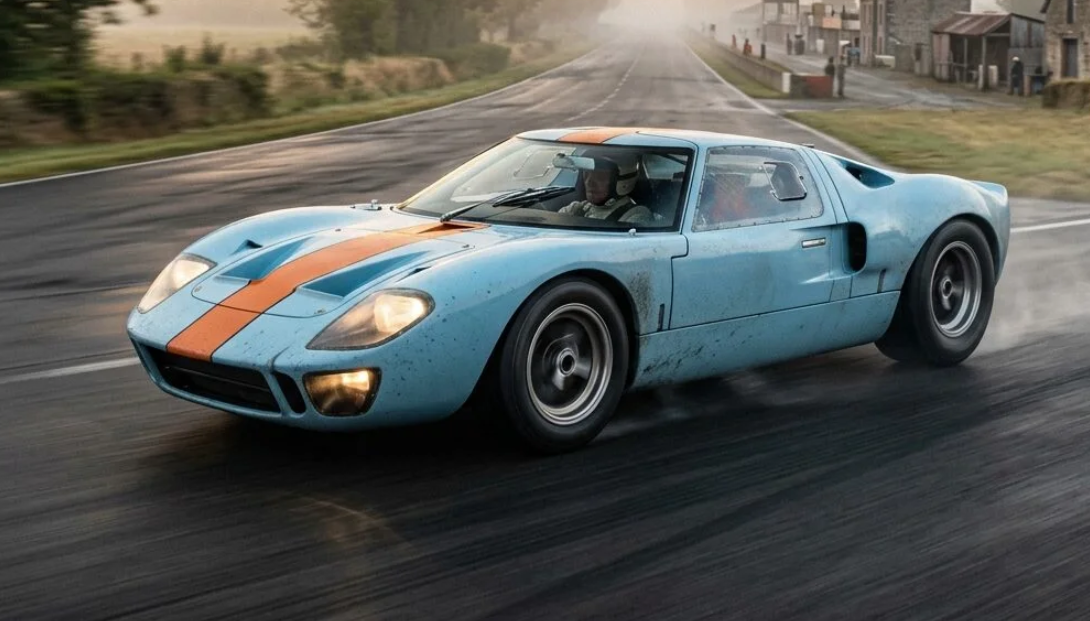
The Racing Car Born From a Rejection
Few racing cars have a story as dramatic as the Ford GT40.
Its origins can be traced to an ambitious plan that connected Detroit, England, and the world’s most famous endurance race. Ford wanted to prove that an American manufacturer could compete at the highest level of European sports-car racing. The target was clear: the 24 Hours of Le Mans and its dominant champion, Ferrari.
The road to victory was anything but easy.
Ford’s first GT40s were fast but unreliable. They suffered from mechanical failures, gearbox problems, crashes, and disappointing finishes. Yet Ford refused to abandon the project. Engineers, drivers, mechanics, and racing specialists gradually transformed the car into one of the most successful endurance racers of the 1960s.
In 1966, that effort finally paid off. Ford GT40 Mark IIs finished first, second, and third at Le Mans. Ford then followed that achievement with another overall victory in 1967, before GT40s won again in 1968 and 1969.
But how did Ford get there?


5
The Beginning: Ford Sets Its Sights on Le Mans
The GT40 story began in the early 1960s, when Ford was looking for a way to expand its presence in international motorsport.
Ford had even explored a potential relationship with Ferrari. When those negotiations ended in 1963, the company decided to pursue its own racing program instead. Ford established a high-performance operation with the goal of developing a car capable of competing successfully in major European endurance races, including Le Mans.
The project brought together an unusual collection of talent.
British engineer Eric Broadley, known for his Lola racing cars, provided important design expertise. Ford engineer Roy Lunn played a major role in developing the vehicle, while John Wyer was brought in to manage the racing operation.
The result was a remarkably low sports car.
The name GT40 reflected one of its most obvious characteristics: the car stood only about 40 inches tall. Ford’s official historical material describes the car as using semi-monocoque steel construction, with its low profile helping provide stability at high speed.
The concept was promising.
The execution still needed work.
1964: Speed Wasn’t Enough
Ford arrived at Le Mans in 1964 with an impressive new machine, but endurance racing demands much more than outright speed.
The GT40 could run extremely quickly down the long Mulsanne Straight. One Ford account notes that one of the cars reached roughly 200 mph during the event.
But none of Ford’s three cars finished the race.
The lesson was brutal but important:
A racing car doesn’t win Le Mans by being fast for a few laps. It has to remain fast for an entire day and night.
That meant Ford needed to strengthen virtually every part of the program.
The company had entered a completely different world of racing, and European endurance competition exposed weaknesses that ordinary testing could not.
1965: More Speed, More Problems
The following year brought further development, but Le Mans remained unforgiving.
Ford experimented with larger engines and different configurations, including a 7.0-liter 427-cubic-inch V8 program. Engineers also worked on aerodynamics, suspension, cooling, transmissions, and weight reduction.
At Shelby American in California, engineers including Phil Remington worked extensively on improving the car’s airflow and mechanical setup. Ford’s historical account says aerodynamic changes produced significant gains, including as much as 79 additional horsepower through improved airflow management.
Yet the 1965 Le Mans effort ended in disappointment.
The GT40s were still not reliable enough to defeat Ferrari.
Ford now had a choice: give up or completely rethink the program.
It chose the second option.


7
The Transformation: Enter the GT40 Mark II
Ford Brings American Racing Know-How to Europe
The breakthrough came when Ford combined its own engineering resources with the expertise of American racing specialists.
For 1966, Ford created a much more coordinated racing organization. Shelby American and Holman & Moody became important parts of the factory effort, combining Shelby’s sports-car experience with Holman & Moody’s NASCAR expertise.
This was more than simply installing a bigger engine.
Ford engineers and racing teams attacked the GT40’s weaknesses one by one.
The 7.0-Liter V8
The GT40 Mark II received a massive Ford V8 with approximately 6.98 liters of displacement.
Ford’s development program targeted both horsepower and durability. The company tested engines under simulated race conditions, attempting to ensure that they could survive considerably longer than the actual 24-hour event. Ford records say the developed engine reached about 485 horsepower while achieving the required endurance testing.
Stronger Mechanical Components
Earlier gearbox failures had been a major problem.
The Mark II received strengthened components designed to withstand the enormous torque produced by the big V8. Interestingly, Ford determined that a four-speed manual transmission was sufficient for the Mark II because of the engine’s tremendous torque output.
Better Brakes
Braking was another enormous challenge.
The cars were approaching extremely high speeds before drivers had to slow dramatically for corners. Heat could damage brake components, making durability just as important as stopping power.
Ford, Shelby American, and component suppliers developed stronger brake materials and faster ways to replace brake components during races. Quick-change solutions allowed teams to minimize the time lost when maintenance became necessary.
Improved Aerodynamics
The GT40’s basic shape was already distinctive, but high-speed endurance racing demanded constant aerodynamic refinement.
Testing included wind-tunnel work and track testing. Engineers explored different nose shapes, airflow arrangements, cooling solutions, and rear-body configurations.
Every small improvement mattered.
The 1966 Daytona Victory Builds Confidence
Before returning to Le Mans, Ford had an important test of its progress.
At the 24 Hours of Daytona in February 1966, Ford’s GT40s dominated the race and finished first, second, and third.
That result was enormously important.
It proved the new Ford endurance strategy could work over an entire 24-hour race. More importantly, it gave the team confidence before its biggest challenge in France.
Now Ford had to do something it had failed to accomplish twice:
Win Le Mans.


5
1966: The GT40 Finally Conquers Le Mans
The 1966 24 Hours of Le Mans became the defining moment in GT40 history.
Ford entered a large factory-backed effort against Ferrari. The race featured intense competition early on, but the endurance nature of Le Mans eventually began to take its toll on the field.
As the hours passed, Ferrari’s cars encountered mechanical problems while the Ford GT40s continued running.
Ford’s strategy changed as the race progressed. Instead of simply chasing maximum lap speed, the teams had to balance pace with reliability.
That was precisely what the previous two years had taught them.
By the closing stages, Ford had control of the race.
The result was historic:
1st — Bruce McLaren / Chris Amon — Ford GT40 Mark II
2nd — Ken Miles / Denny Hulme — Ford GT40 Mark II
3rd — Ronnie Bucknum / Dick Hutcherson — Ford GT40 Mark II
The three Ford cars completed a remarkable 1-2-3 finish.
The winning car completed 360 laps, covering more than 4,843 kilometers at an average speed above 210 km/h.
Ford had finally done what it set out to accomplish.
It had beaten Ferrari at Le Mans.
The Controversial Finish
The 1966 victory also became famous for a fascinating finishing controversy.
Ken Miles had been one of the central figures in developing and testing the winning GT40. His car was running alongside the Bruce McLaren/Chris Amon car toward the end.
Ford wanted the cars to finish together.
They crossed the finish line in what appeared to be a dead heat, but because of the starting positions and the distance each car had traveled, the official result awarded the victory to McLaren and Amon.
For Miles, the outcome was particularly painful.
He had been deeply involved in the development of the Mark II and had already helped Ford achieve major endurance victories earlier in the season.
Still, the result became part of Le Mans folklore.
And the most important fact remained unchanged:
Ford had defeated Ferrari.
1967: Ford Goes Back for More
Winning Le Mans once could have been treated as a fluke.
Ford wanted to prove otherwise.
For 1967, the company introduced the Ford Mark IV, a further development of its Le Mans racing effort. It featured a substantially revised body and continued Ford’s commitment to high-performance endurance racing.
This time, the winning combination was Dan Gurney and A.J. Foyt.


7
An All-American Victory
The 1967 victory was another milestone.
Gurney and Foyt drove the Ford Mark IV to overall victory, completing 5,232.9 kilometers during the 24-hour race. Le Mans records list the Ford’s winning average speed at more than 218 km/h.
The victory was significant because it demonstrated that Ford’s 1966 success was not a one-off achievement.
The company had developed an endurance-racing system capable of winning repeatedly.
Ford’s 1967 victory also became part of the car’s long-term legacy. Decades later, Ford created a GT Heritage Edition inspired by the Mark IV’s winning red-and-white livery and the Gurney-Foyt victory.
1968 and 1969: The GT40 Becomes a Legend
Ford’s Le Mans story didn’t end in 1967.
In 1968, the Ford GT40 returned to the top step of the podium with Pedro Rodríguez and Lucien Bianchi.
The following year, another GT40 produced one of the most dramatic finishes in Le Mans history.


8
Jacky Ickx and the 1969 Finish
The 1969 race became legendary for several reasons.
Jacky Ickx deliberately walked to his car at the start rather than sprinting across the track, protesting the traditional Le Mans start and the danger it created for drivers rushing to get underway.
He and teammate Jackie Oliver then fought their way through a brutal 24-hour contest.
At the finish, their Ford GT40 crossed the line only about two seconds ahead of the Porsche 908.
According to Le Mans historical statistics, the 1969 GT40 victory remains one of the race’s most memorable close finishes.
It was the fourth Ford victory at Le Mans in a five-year span from 1966 through 1969.
What Made the Ford GT40 So Successful?
The GT40 wasn’t successful because of one magical component.
Its success came from combining several strengths.
1. A Powerful Ford V8
The big American V8 gave the GT40 enormous straight-line performance and the torque necessary for long-distance racing.
2. Constant Engineering Development
Ford didn’t simply build the car and hope for the best. Engineers continuously changed the brakes, suspension, cooling, aerodynamics, gearbox, engine, and bodywork.
3. American Racing Expertise
The involvement of Shelby American and Holman & Moody brought valuable racing knowledge to the program. Ford’s internal engineering resources could then be combined with practical experience from people accustomed to preparing cars for competition.
4. Driver Feedback
Drivers such as Ken Miles, Bruce McLaren, Chris Amon, Dan Gurney, A.J. Foyt, and Jacky Ickx were not merely steering the cars.
Their feedback helped engineers understand what worked and what needed to change.
5. Reliability Became the Priority
The early GT40s proved that speed alone wasn’t enough.
By 1966, Ford understood that a Le Mans car needed to survive the race first and win it second.
That change in philosophy was arguably the most important improvement of all.
Was the GT40 Really an American Car?
This is one of the most interesting questions about the GT40.
The answer is complicated.
The original GT40 program had deep British roots. Ford worked with British engineering talent, and the early cars were developed and built in England.
But American money, engineering, engines, racing expertise, and organizational support were essential to transforming the GT40 into a Le Mans winner.
The Mark II in particular represented a powerful transatlantic collaboration.
British chassis and racing experience met American V8 power and American competition expertise.
So rather than being simply an American or British creation, the GT40 is better understood as an international racing project driven by Ford’s determination to win.
The GT40’s Lasting Legacy
The Ford GT40 became much more than a successful racing car.
It changed how Ford was perceived in international motorsport.
Before the GT40, Ford was not regarded as an established Le Mans powerhouse. After 1966, it had become one of the defining manufacturers in endurance racing.
The achievements also became part of Ford’s identity decades later.
When Ford returned to Le Mans with the modern Ford GT in 2016, the company deliberately connected the new car to the historic GT40. Ford’s 2016 GT program even celebrated the 50th anniversary of the 1966 victory, while Heritage Editions later paid tribute to the original winning cars.
The GT40 therefore isn’t remembered simply because it was fast.
It represents persistence.
Ford failed in 1964.
It failed again in 1965.
Instead of walking away, the company studied those failures and rebuilt the program.
That is what makes the GT40 story so compelling.


6
Final Thoughts: From Failure to Le Mans Legend
The Ford GT40 story is ultimately a story about refusing to accept failure.
Ford entered Le Mans wanting to challenge Ferrari. Its first attempts demonstrated speed but exposed serious weaknesses. Engineers went back to work, racing teams changed their methods, drivers provided relentless feedback, and the entire program became more disciplined.
Then came 1966.
The GT40 Mark II finished first, second, and third.
Ford returned to win again in 1967, and GT40s continued their remarkable run with victories in 1968 and 1969. Le Mans records credit Ford with four victories during that era, cementing the GT40 as one of endurance racing’s defining machines.
The GT40 proved something important about motorsport:
Great racing cars aren’t always born perfect. Sometimes they’re created through failure, experimentation, persistence, and the determination to come back stronger.
That is why the Ford GT40 remains one of the most recognizable and celebrated racing cars in automotive history.
It didn’t simply win Le Mans.
It earned its legend one difficult mile at a time.

One thought on “How America Built the Ford GT40”