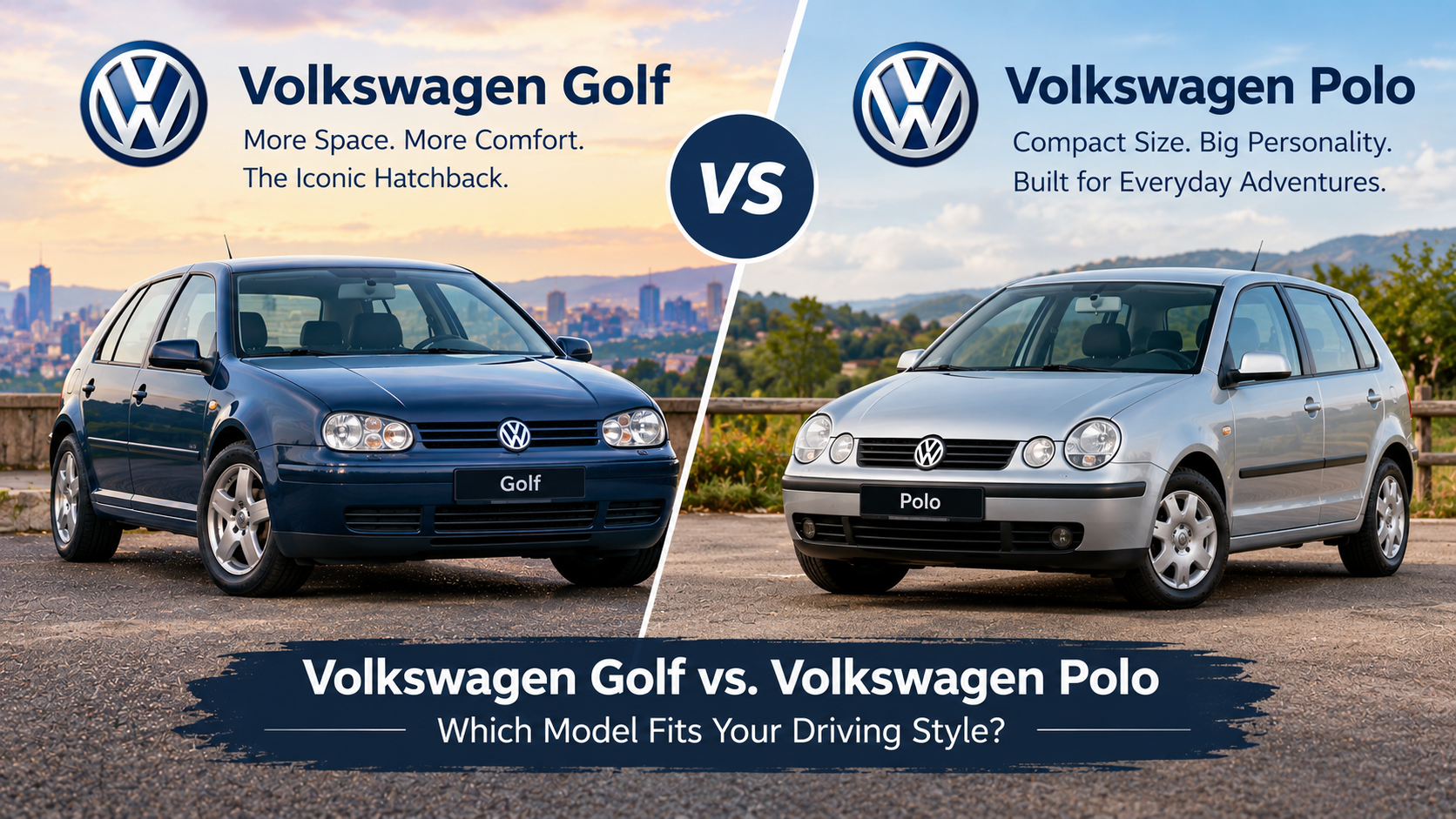
Choosing between the Volkswagen Golf and Volkswagen Polo can be surprisingly difficult. Both are compact Volkswagen hatchbacks, both offer modern technology and efficient engines, and both can work well as everyday cars. Yet they are designed around somewhat different priorities.
The Polo sits in the smaller-car class, making it particularly suitable for drivers who spend a lot of time in urban areas and want a compact footprint. The Golf is larger and offers a broader range of configurations, giving it a more versatile role for drivers who regularly carry passengers, travel longer distances, or want additional performance and equipment options.
Volkswagen describes the Polo as a compact car measuring just over four metres in length, while the current Golf is positioned as a larger hatchback with a range of petrol, mild-hybrid and other configurations depending on market.
So, which one fits your driving style?
The answer depends less on the badge and more on where you drive, how much space you need, what kind of performance you want, and how you use your car every day.
Volkswagen Golf vs. Volkswagen Polo at a Glance
| Category | Volkswagen Polo | Volkswagen Golf |
|---|---|---|
| Overall size | Smaller and easier to maneuver | Larger and more spacious |
| Urban driving | Very well suited to compact streets and parking | Easy to drive, but larger |
| Interior space | Practical for its class | More room for passengers |
| Boot practicality | Good for a small hatchback | Generally more versatile |
| Performance range | Efficient everyday engines plus sporty versions | Broader range of powertrains and performance versions |
| Long-distance driving | Capable and comfortable | Particularly suited to longer journeys |
| Fuel economy | Can be very efficient depending on engine | Efficient, with more powertrain choices |
| Parking | Compact dimensions are an advantage | Requires slightly more space |
| Driving character | Light, agile and compact | More substantial and versatile |
| Best suited to | City users and smaller households | Drivers wanting one car for many purposes |
Exact specifications, equipment, engines, and fuel-consumption figures depend on model year, trim, engine and market.
Step 1: Compare the Size
Size is one of the clearest differences between the Polo and Golf.
The current combustion-engine Polo is approximately 4,074 mm long, 1,751 mm wide and 1,451 mm high, according to Volkswagen’s published comparison data.
The Golf occupies a larger class, giving it additional exterior and interior space.
Why Size Matters
A smaller car can be easier to position in:
- Narrow city streets
- Busy parking areas
- Small residential garages
- Crowded shopping centers
- Tight urban traffic
The Golf’s larger dimensions, meanwhile, can provide advantages when carrying passengers and luggage.
For City Drivers
If your daily routine involves frequent parking, short trips and congested streets, the Polo’s compact footprint can be useful.
For Mixed Driving
If your driving includes cities, highways, family trips and longer journeys, the Golf’s additional space becomes more relevant.
Step 2: Look at Interior Comfort
Both cars can provide a modern Volkswagen-style cabin, but their proportions are different.
The Polo has been designed to make good use of its compact dimensions. Volkswagen highlights its digital operating concept, connectivity and driver-assistance technology among its key features.
The Golf generally provides a larger cabin environment, which can be especially noticeable for passengers and longer journeys.
Front Seats
For the driver and front passenger, both models can offer comfortable seating and modern controls.
The difference becomes more noticeable when the vehicle is regularly occupied by several adults.
Rear Seats
If you frequently carry adults in the rear, the Golf’s larger overall package can make it a more natural choice.
For occasional rear passengers, the Polo can still provide a practical solution.
Step 3: Compare Performance
Performance depends heavily on the exact engine and trim.
Volkswagen has offered the Polo with several small petrol engines, including turbocharged 1.0-litre TSI versions. The company has also produced performance-oriented Polo GTI models.
The Golf has a broader powertrain and performance range in many markets. Volkswagen’s current UK Golf range, for example, includes petrol and mild-hybrid configurations, with different equipment and power outputs available depending on trim.
Polo Driving Character
The Polo’s smaller dimensions and relatively light-footed character can make it enjoyable in everyday urban driving.
It can feel particularly natural when:
- Changing lanes in city traffic
- Making tight turns
- Parking
- Driving on narrow roads
Golf Driving Character
The Golf offers a larger-car feel while remaining compact enough for everyday use.
Depending on the version, it can provide:
- More powerful engines
- More long-distance capability
- Greater performance potential
- Additional drivetrain and equipment choices
For drivers who want one vehicle capable of handling commuting, family duties and enthusiastic driving, the Golf’s broader range of configurations is significant.
Step 4: Fuel Economy
Fuel economy is one of the areas where comparisons need careful attention.
There isn’t one universal “Golf fuel economy” or “Polo fuel economy” figure. Consumption varies according to:
- Engine
- Transmission
- Wheels and tires
- Vehicle equipment
- Driving conditions
- Model year
- Testing standard
- Market
Volkswagen’s published Polo information, for example, has included different consumption figures for different engines and configurations.
The current Golf also has multiple powertrain options, meaning two Golf models can have substantially different consumption figures.
Which Should You Consider for Economy?
If your priority is minimizing fuel consumption during urban commuting, a smaller Polo with an efficient engine may make sense.
If you drive long distances, however, don’t look at fuel consumption alone. Consider the complete package, including comfort, luggage space, engine performance and annual mileage.
Step 5: Practicality and Boot Space
A car’s usefulness isn’t determined only by its exterior dimensions.
Think about what you normally carry.
Do you regularly transport:
- Groceries?
- Children’s equipment?
- Suitcases?
- Sports equipment?
- Work bags?
- Shopping?
- Family passengers?
Polo Practicality
The Polo provides useful hatchback practicality without taking up as much road space as a larger car.
It can be particularly convenient for:
- Singles
- Couples
- Small families
- City commuters
- Drivers who rarely carry large loads
Golf Practicality
The Golf’s larger overall package gives it more flexibility for passengers and luggage.
It can be a better match for drivers who want their hatchback to perform several roles rather than primarily serving as a city commuter.
Step 6: City Driving and Parking
This is where the Polo’s compact dimensions can become particularly valuable.
Imagine arriving at a busy shopping area with limited parking. A smaller footprint can make finding and using a parking space easier.
Why the Polo Works Well in Cities
Its compact size can make it convenient for:
- Parallel parking
- Narrow streets
- Tight parking garages
- Short urban trips
- Frequent stop-and-go driving
The Golf in the City
The Golf remains a manageable urban car, but its larger dimensions mean drivers should consider their regular parking environment.
If you have a spacious driveway and mostly open roads, the difference may matter less.
Step 7: Highway and Long-Distance Driving
The Golf’s additional size and broader range of engines and equipment can become more noticeable on longer journeys.
Golf on Longer Journeys
For frequent highway driving, the Golf can offer the type of larger-car environment that many drivers appreciate.
Depending on specification, available features can include technologies such as adaptive cruise control, navigation, parking sensors and other assistance systems. Volkswagen’s current Golf information lists several of these features on selected configurations.
Polo on Longer Journeys
The Polo isn’t limited to city driving. Volkswagen itself describes the modern Polo as an everyday car capable of going beyond urban environments.
For occasional road trips, the Polo can therefore be perfectly practical.
Step 8: Technology and Features
Modern versions of both cars can offer digital displays, connectivity and driver-assistance features.
The exact equipment depends heavily on trim level.
Golf Technology
Volkswagen’s current Golf listings include features such as a large infotainment display, navigation, adaptive cruise control and front/rear parking sensors on selected configurations.
Polo Technology
The Polo has also moved well beyond the basic small-car formula, with Volkswagen highlighting digital controls, connectivity and driver-assistance technology.
When comparing actual vehicles for purchase, compare trim against trim, rather than assuming every Golf has more equipment than every Polo.
Step 9: Ownership Considerations
Buying the car is only the beginning. Ownership costs can include:
- Fuel
- Insurance
- Routine servicing
- Tires
- Brake components
- Batteries
- Repairs
- Accessories
- Depreciation
- Registration and taxes, depending on location
A smaller Polo may be attractive for drivers whose priorities include compact dimensions and efficient everyday transportation.
The Golf may appeal to someone willing to operate a somewhat larger vehicle in exchange for additional space and a broader range of configurations.
Used Volkswagen Buyers
For a used Golf or Polo, condition can matter more than simply choosing one model over the other.
Before buying, check:
Maintenance History
Look for evidence of regular servicing and repairs.
Mileage
Mileage should be considered alongside maintenance history and vehicle condition.
Tires and Brakes
These can represent immediate replacement costs if they are near the end of their service life.
Engine and Transmission
Check for warning lights, unusual noises, poor shifting, leaks and other signs that require professional inspection.
Electronics
Test infotainment, windows, lights, parking sensors, climate controls and other electrical equipment.
Step 10: Which Driving Style Matches Each Model?
Instead of asking which model is universally better, consider the type of driving you actually do.
The Polo May Suit You If You:
- Spend most of your time in cities
- Frequently park in tight spaces
- Prefer a smaller car
- Usually travel alone or with one or two passengers
- Want a compact hatchback
- Don’t regularly carry large amounts of luggage
The Golf May Suit Your Needs If You:
- Regularly carry passengers
- Take frequent road trips
- Want more cabin and luggage flexibility
- Prefer a larger hatchback
- Want access to a wider range of powertrains and performance versions
- Use one vehicle for commuting, family duties and longer journeys
These are usage-based distinctions rather than a universal ranking: the right choice depends on the vehicle’s exact specification and the driver’s circumstances.
Golf vs. Polo: A Real-World Example
Imagine two drivers.
Driver A: The Urban Commuter
They drive 15–20 minutes to work, park on crowded city streets, shop locally and rarely carry more than two passengers.
For this type of routine, the Polo’s compact dimensions can be particularly useful.
Driver B: The Weekend Traveler
They commute during the week but regularly travel with family on weekends, carry luggage and spend several hours on highways.
For this routine, the Golf’s larger interior and broader range of configurations may be more relevant.
Neither scenario requires the same vehicle.
Don’t Forget the Model Year
One important point when researching a Golf vs. Polo comparison is that model generations matter.
A 2015 Polo and a 2026 Polo are not equivalent vehicles. The same applies to the Golf.
Specifications can change considerably between generations, including:
- Engine choices
- Dimensions
- Safety technology
- Infotainment
- Fuel economy
- Interior design
- Driver-assistance systems
- Boot capacity
- Performance
Volkswagen’s published technical documents demonstrate how specifications change between generations and markets.
Therefore, anyone shopping for a particular used Volkswagen should compare the exact model year and engine rather than relying on a general Golf-versus-Polo description.
Final Thoughts: Golf or Polo?
The Volkswagen Polo and Volkswagen Golf serve different purposes while sharing many of the qualities that have made Volkswagen’s compact cars popular.
The Polo emphasizes compact dimensions, easy urban maneuverability and practical everyday transportation. The Golf occupies a larger class and offers additional space and a broader selection of powertrain and equipment configurations.
Before making a purchase, consider your typical journey rather than an occasional one.
Ask yourself:
- How much time do I spend driving in cities?
- How often do I carry rear passengers?
- How much luggage do I normally carry?
- Do I frequently drive on highways?
- Is parking space limited?
- What engine and transmission do I actually need?
- What are the servicing and insurance costs in my market?
- Which model year and trim am I comparing?
Once those questions are answered, the difference between the two becomes much clearer.
The Golf and Polo aren’t simply two versions of the same idea. They are Volkswagen hatchbacks designed around different combinations of size, practicality, performance and everyday use—and understanding those differences is the key to finding the model that matches your own driving routine.