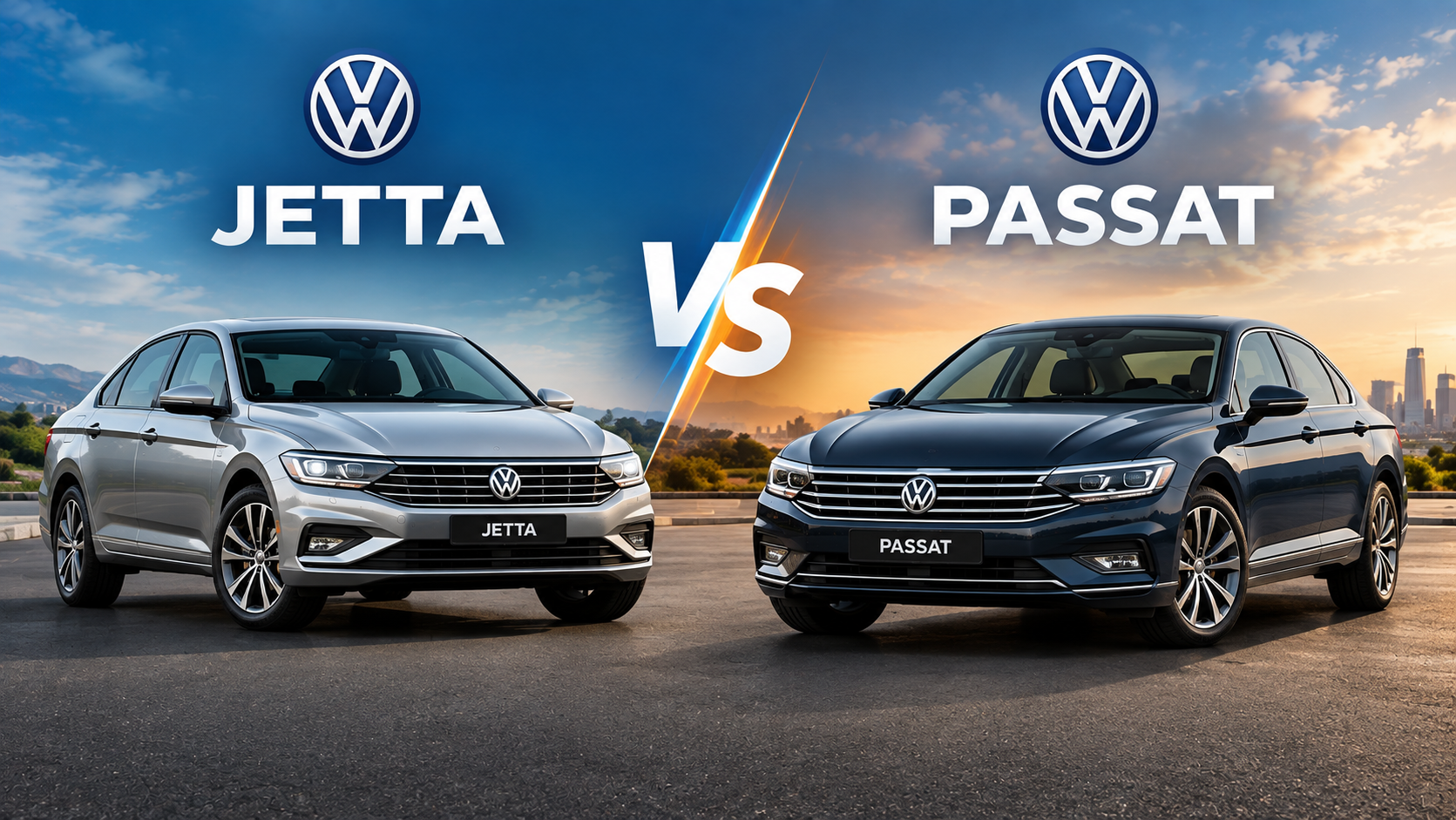
The Volkswagen Jetta and Volkswagen Passat have both played important roles in Volkswagen’s sedan history. For years, they gave buyers a choice between a more compact everyday car and a larger, more spacious family-oriented model.
But there is an important detail modern shoppers should know: the Jetta and Passat are no longer positioned identically in every market. The current Jetta remains a compact sedan in markets such as North America, while the newest Passat in Europe is a larger estate/wagon rather than a traditional sedan. Volkswagen describes the ninth-generation Passat as a model with more than 50 years of history and more than 34 million vehicles sold, while its current European specification emphasizes passenger and cargo space.
For buyers considering a used Passat sedan, however, the comparison remains highly relevant.
So how do these two Volkswagen models differ in size, performance, comfort, practicality, fuel economy, technology, and ownership?
Let’s take a closer look.
Volkswagen Jetta vs. Passat at a Glance
| Category | Volkswagen Jetta | Volkswagen Passat |
|---|---|---|
| Vehicle positioning | Compact sedan | Larger midsize model; current European Passat is an estate |
| Exterior size | More compact | Larger |
| City driving | Easy to maneuver | More space required |
| Passenger space | Practical | Generally more spacious |
| Cargo flexibility | Large sedan trunk | Current Variant offers substantially greater cargo capacity |
| Performance | Turbocharged options depending on market | Wider range depending on generation and market |
| Long-distance comfort | Strong | Traditionally a major Passat strength |
| Technology | Modern equipment on current models | Extensive technology on newer generations |
| Best for | Daily commuting and mixed driving | Families, long-distance travel and greater cargo needs |
Specifications vary by model year, engine, trim and market.
1. Size: Jetta or Passat?
The first major difference is physical size.
The Jetta has traditionally occupied the compact-sedan category. Volkswagen’s current U.S.-market Jetta measures around the dimensions expected of a compact sedan and provides 37.4 inches of rear legroom along with a 14.1-cubic-foot trunk.
Older Passat sedans were positioned above the Jetta and generally offered a larger cabin and more substantial road presence.
Why Size Matters
A smaller sedan can be easier to use in crowded urban areas.
The Jetta’s dimensions can make it convenient for:
- City commuting
- Tight parking spaces
- Daily errands
- Small garages
- Individual or small-family use
The larger Passat, meanwhile, has historically been designed around greater passenger comfort and longer-distance practicality.
2. Interior Comfort
Both cars can provide a comfortable Volkswagen-style cabin, but their intended positioning is different.
The Jetta’s current interior includes features such as available wireless smartphone connectivity and modern infotainment equipment depending on trim. Volkswagen describes the current Jetta as offering a comfortable interior alongside its compact-sedan format.
Front Passengers
For the driver and front passenger, both models can provide comfortable seating and good visibility.
The difference becomes more noticeable when the car regularly carries several adults.
Rear Passengers
The Passat has traditionally emphasized rear-seat space, making it attractive for families and passengers who spend considerable time in the back.
The Jetta remains practical, but buyers should consider their normal passenger requirements rather than simply looking at the vehicle’s badge.
3. Performance and Driving Experience
Performance depends heavily on the specific generation and engine.
The current U.S.-market Jetta uses a 1.5-liter TSI turbocharged four-cylinder producing 158 horsepower and 184 lb-ft of torque, paired with an eight-speed automatic transmission in the specification shown by Volkswagen.
Jetta Driving Character
The Jetta’s compact dimensions and turbocharged engine make it well suited to everyday driving.
It can work particularly well for drivers who want:
- Easy urban maneuverability
- Responsive acceleration
- Comfortable commuting
- Highway capability
- Reasonable fuel economy
Passat Driving Character
The Passat has traditionally been designed as a more substantial long-distance car.
Depending on generation and market, Passat buyers have had access to petrol and diesel engines, automatic transmissions, and in some versions four-wheel drive.
The newer European Passat also offers plug-in-hybrid technology, with Volkswagen quoting approximately 100 km of electric range under its stated test conditions for the relevant version.
4. Fuel Economy
Fuel economy cannot be compared fairly using the model names alone.
A Jetta with one engine may consume significantly less fuel than a Passat with a larger engine, but an efficient Passat powertrain can narrow the difference.
Fuel consumption depends on:
- Engine
- Transmission
- Vehicle weight
- Wheel and tire configuration
- Driving style
- Model year
- Road conditions
- Testing procedure
For example, Volkswagen’s current Jetta specification lists 29 mpg city and 40 mpg highway under U.S. EPA estimates for the stated configuration.
What This Means for Buyers
If your driving consists mainly of commuting and errands, the Jetta’s compact format and efficient turbocharged engine can make sense.
If you regularly travel long distances with several passengers and luggage, fuel economy should be considered together with comfort and cargo capacity.
5. Practicality and Cargo Space
This is one of the biggest reasons people have traditionally chosen a Passat over a Jetta.
The current Jetta has a 14.1-cubic-foot trunk, which is a useful amount of sedan cargo space.
The newest European Passat, however, is an estate/wagon. Volkswagen lists 690 liters of cargo space, increasing to 1,920 liters with the rear seats folded.
Jetta Cargo Area
The Jetta’s trunk is useful for:
- Groceries
- Work bags
- Suitcases
- Shopping
- Everyday family items
Its traditional sedan shape keeps the passenger cabin separate from the trunk.
Passat Cargo Area
The current Passat Variant is a different proposition.
Its wagon body makes it much easier to carry:
- Large suitcases
- Bicycles
- Strollers
- Sports equipment
- Camping gear
- Large shopping loads
For buyers who need maximum cargo flexibility, the current Passat’s estate design is an important consideration.
6. City Driving and Parking
If you live in a busy city, vehicle size can affect your everyday experience.
Jetta in the City
The Jetta’s compact-sedan dimensions can make it easier to position in:
- Narrow streets
- Parking garages
- Busy shopping areas
- Residential parking spaces
For drivers who spend most of their time in urban environments, this can be an important advantage.
Passat in the City
The larger Passat can still be perfectly manageable, especially with parking sensors and cameras where equipped.
However, its larger body is more noticeable when navigating tight spaces.
7. Highway Comfort
Long-distance driving is an area where the Passat’s traditional positioning becomes particularly relevant.
The Passat has historically been designed as a comfortable family and business-travel vehicle.
Newer Passat models add technologies such as adaptive chassis control, advanced lighting, driver-assistance systems and upgraded seating depending on specification. Volkswagen’s ninth-generation Passat information highlights optional ergoActive seats, DCC Pro adaptive running gear and IQ.LIGHT LED matrix headlights.
The Jetta can also be a capable highway car. Volkswagen’s current Jetta uses a turbocharged engine and eight-speed automatic transmission in the U.S. specification, giving it the equipment needed for regular highway travel.
8. Technology and Safety Features
Modern Volkswagen vehicles have become increasingly technology-focused.
Depending on model year and trim, buyers may find:
- Digital instrument displays
- Touchscreen infotainment
- Smartphone integration
- Adaptive cruise control
- Parking sensors
- Rear-view cameras
- Lane-assistance technology
- Automatic emergency braking
- LED lighting
The exact availability varies substantially by generation and market, so buyers should check the equipment list of the specific vehicle they are considering.
Volkswagen’s current Jetta information, for example, lists modern connectivity and assistance technologies, while the current Passat introduces newer systems on selected versions.
9. Ownership and Maintenance
Buying either Volkswagen requires looking beyond the purchase price.
Consider the complete ownership picture:
Fuel
Estimate your annual mileage and typical fuel consumption.
Tires
Larger wheels can sometimes mean more expensive replacement tires.
Brakes
Brake-pad and disc costs vary by engine, trim and brake system.
Servicing
Follow the maintenance schedule appropriate to the exact engine and model year.
Insurance
Insurance costs vary according to location, driver, vehicle age and specification.
Replacement Parts
Older Passats and Jettas may have different parts availability depending on generation and market.
Used-Car Condition
With a used Volkswagen, service history can be extremely important.
Before purchasing, inspect:
- Engine condition
- Transmission operation
- Suspension
- Brakes
- Tires
- Air conditioning
- Electrical systems
- Infotainment
- Warning lights
- Previous accident damage
- Maintenance records
10. Buying a Used Jetta vs. Used Passat
The used-car market makes this comparison especially interesting.
A used Jetta can be attractive to someone looking for a practical Volkswagen sedan without the dimensions of a larger family car.
A used Passat sedan can appeal to someone who wants additional cabin space and long-distance comfort.
What to Check on a Used Jetta
Look carefully at:
- Maintenance history
- Turbocharger condition
- Transmission operation
- Suspension wear
- Brake condition
- Tire age
- Air-conditioning performance
- Electrical equipment
What to Check on a Used Passat
Because Passat models have been offered with a wider variety of engines and drivetrains over the years, identify the exact engine and transmission before purchasing.
Pay particular attention to:
- Service history
- Engine leaks
- Transmission behavior
- Cooling system
- Suspension
- Diesel emissions equipment where applicable
- Electronic systems
- Timing-belt requirements where applicable
A professional pre-purchase inspection can help identify expensive problems before the sale.
11. Jetta vs. Passat: Which Type of Driver Is Each For?
Rather than declaring one model universally better, think about your driving routine.
The Jetta Makes Sense for Drivers Who:
- Mostly commute to work
- Drive in urban areas
- Want a compact sedan
- Usually carry one or two passengers
- Need a useful trunk
- Want a modern Volkswagen without a larger body
The Passat Makes Sense for Drivers Who:
- Frequently carry passengers
- Take long highway trips
- Need more passenger space
- Carry substantial luggage
- Want a larger family vehicle
- Are considering a used Passat sedan or a newer Passat Variant depending on market
12. What About the New Passat?
This is an important consideration for anyone researching the model today.
Volkswagen’s ninth-generation Passat is no longer offered as a traditional sedan in Europe. It is available as the Passat Variant, giving the model a much stronger emphasis on cargo capacity and family practicality. Volkswagen lists a 4,917 mm overall length and up to 1,920 liters of cargo space with the rear seats folded.
That means today’s comparison isn’t simply:
Small sedan vs. large sedan.
In some markets it is closer to:
Compact sedan vs. large family estate.
That distinction matters when comparing new vehicles.
13. Which One Fits Different Driving Scenarios?
Mostly City Driving
A Jetta’s smaller dimensions may be easier to live with when parking and maneuvering are daily concerns.
Daily Commuting
Both can work well, with the exact engine and transmission influencing fuel consumption and driving character.
Family Transportation
The Passat’s larger cabin and, in its current Variant form, much greater cargo flexibility can be useful for families.
Frequent Road Trips
The Passat’s traditional focus on long-distance comfort makes it particularly relevant for drivers who spend many hours on highways.
Occasional Trips and Everyday Errands
The Jetta provides a practical sedan format without the additional size of a larger vehicle.
Final Thoughts
The Volkswagen Jetta and Volkswagen Passat represent two different approaches to everyday Volkswagen ownership.
The Jetta is a compact sedan with a useful trunk, modern technology and turbocharged power in its current U.S. specification. Volkswagen currently lists 158 horsepower, 184 lb-ft of torque, 14.1 cubic feet of trunk space and 37.4 inches of rear legroom for the model.
The Passat has traditionally occupied a larger, more spacious position in Volkswagen’s lineup. Today, its latest European generation has evolved into a large estate with substantial passenger and cargo capacity, while older Passat sedans remain relevant on the used market.
The most useful way to choose between them is to start with your own driving needs.
If you value compact dimensions, easy everyday driving and sedan practicality, investigate the Jetta.
If you prioritize passenger room, long-distance comfort and maximum cargo flexibility, a Passat—particularly the current Variant where available—may better match those requirements.
And if you’re buying used, remember that model year, engine, transmission, maintenance history and condition can matter just as much as the model name.
The right Volkswagen isn’t simply the one with the larger engine or longer equipment list. It’s the one that fits the way you actually drive.