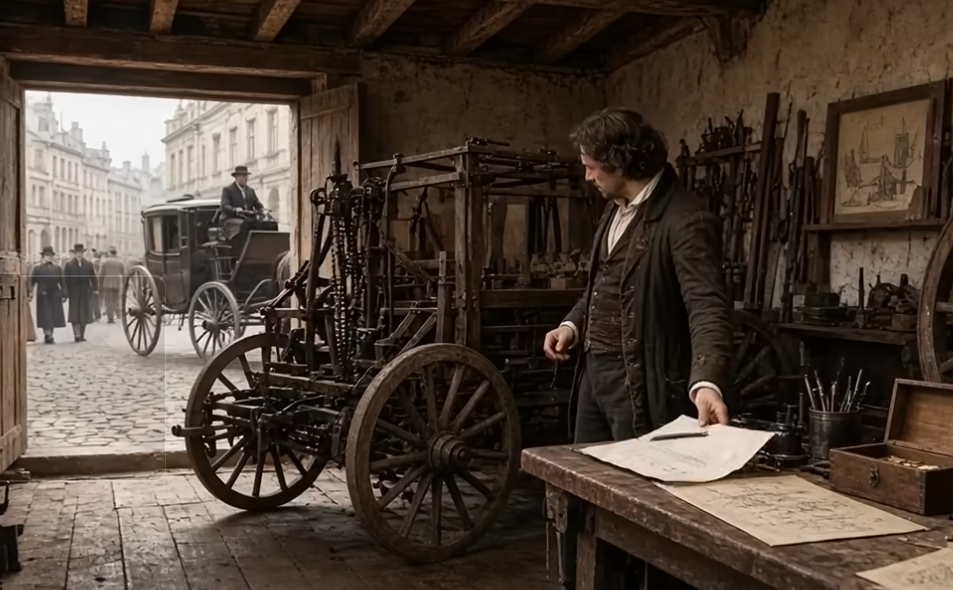

Featured image suggestion: The original 1886 Benz Patent-Motorwagen, widely recognized as the world’s first practical gasoline-powered automobile.
Imagine a world where every journey depends on a horse, a carriage, or a train. There are no modern highways, no traffic lights, and no cars waiting outside homes. In this world, the idea of a machine that can carry people along roads using its own engine sounds almost impossible.
Yet one determined engineer believed transportation could be different.
His name was Carl Benz, a German inventor who dreamed of building a vehicle powered by an engine rather than a horse. His idea required more than imagination. He needed mechanical knowledge, patience, money, and the courage to pursue a technology that many people had never seen before.
In the 1880s, Benz brought his vision to life by developing the Patent-Motorwagen, a three-wheeled vehicle powered by a gasoline engine. He filed its landmark patent on January 29, 1886, a date widely regarded as a defining moment in automobile history.
Mercedes-Benz Group
+1
But the invention was only the beginning. The machine had to work, people had to trust it, and the public needed a reason to believe that motorized transportation had a future.
This is the story of the fearless engineer who helped change how the world moves—and the remarkable woman whose daring journey helped prove that his invention could work beyond the workshop.
1. A Young Engineer With an Unusual Dream

Carl Benz was born in 1844 in what is now Germany. From an early age, he developed an interest in machines and engineering. At a time when transportation depended heavily on animal power and steam technology, he became fascinated by the possibility of using compact engines to move vehicles.
Benz studied mechanical engineering and gained practical experience before attempting to build a machine of his own. He understood that inventing a new form of transportation would require solving several difficult problems at once.
An engine needed to produce enough power without being too heavy. The vehicle needed a frame strong enough to carry passengers. Its wheels needed to turn reliably, and the driver needed a way to control its direction and speed.
These challenges were connected. A powerful engine was of little use if the vehicle was too heavy, difficult to steer, or constantly breaking down.
Rather than abandoning his idea, Benz treated each obstacle as an engineering problem to be solved.
Why his vision was different
Benz wasn’t simply interested in attaching an engine to an existing carriage. He wanted to create a purpose-built motor vehicle in which the engine, frame, steering, and drive system worked together as a complete machine.
Mercedes-Benz Group
+1
That approach helped distinguish his work from other experiments with motorized transportation.
2. Turning an Idea Into a Working Engine

Before Benz could build a successful automobile, he needed a dependable engine.
His early engine-development work provided the foundation. In 1879, a stationary two-stroke gasoline engine developed by Benz ran successfully. Its commercial potential helped him devote more attention to his larger ambition: creating a lightweight vehicle that could carry its own power source.
Mercedes-Benz Group
But a stationary engine and an automobile engine faced different demands.
An engine intended for a vehicle needed to be compact enough to fit on the chassis and light enough to avoid overwhelming the structure. It also had to operate reliably while the vehicle moved over uneven roads.
Benz continued refining his ideas, working toward a system that could power a vehicle without requiring an animal to pull it.
The challenge was not simply to make an engine run. It was to make the engine useful for transportation.
That distinction would become one of the most important parts of his achievement.
3. The Birth of the Patent-Motorwagen

By 1885, Benz had built a remarkable machine: the Patent-Motorwagen.
Unlike a traditional horse-drawn carriage, it was designed around its own internal-combustion engine. It featured three wire-spoked wheels, a tubular steel frame, and a compact four-stroke, single-cylinder engine mounted at the rear.
The engine produced approximately 0.75 horsepower. That figure seems tiny beside modern cars, but the machine represented a major engineering achievement for its time.
Mercedes-Benz Group
+1
How did the first car work?
The basic process was straightforward in principle:
- Fuel: Gasoline supplied the energy needed by the engine.
- Combustion: The engine converted fuel energy into mechanical motion.
- Transmission: A belt-drive arrangement transferred power toward the driving wheels.
- Steering: A dedicated steering mechanism allowed the driver to guide the three-wheeled vehicle.
- Chassis: A lightweight frame supported the engine, wheels, and passenger seat.
These parts had to work together in a machine that was still experimental.
The result looked nothing like a modern family sedan. It resembled a combination of a lightweight carriage and a mechanical workshop project, with exposed components and an engine that passengers could see and hear.
Yet it demonstrated something extraordinary: a gasoline-powered vehicle could carry people without a horse.
4. January 29, 1886: The Patent That Changed Transportation

On January 29, 1886, Carl Benz applied for a patent for his gas-engine-powered vehicle. The patent, numbered DRP 37435, is widely considered a landmark document in the history of the automobile.
Mercedes-Benz Group
+1
It was more than a piece of paperwork.
The patent documented a new approach to personal transportation, built around a vehicle designed to propel itself using an engine.
Benz’s invention did not instantly create the modern automotive industry. Roads, fuel supplies, maintenance facilities, manufacturing methods, and public acceptance all had to develop over time.
But the patent marked a crucial step from experimental engineering toward a new kind of mobility.
Why the invention mattered
Before practical motorcars became available, most ordinary road journeys depended on horses or other established forms of transport. A self-propelled vehicle offered the possibility of traveling without relying on an animal to provide the pulling force.
The Patent-Motorwagen demonstrated that this possibility was real.
Benz had transformed an ambitious idea into a working invention—and the world was beginning to take notice.
5. When the World Wasn’t Yet Convinced

Creating an invention and convincing people to use it are two very different challenges.
In the 1880s, the automobile was unfamiliar. People were accustomed to horses, carriages, bicycles, and trains. A small machine with an exposed engine and unfamiliar controls could hardly compete with transportation methods that people already understood.
Potential customers had reasonable questions.
Would the vehicle start when needed? Could it travel a useful distance? What happened if it broke down on the road? Where could its owner obtain fuel or repairs?
Benz needed to show that his creation could do more than move around a workshop or make an impressive appearance during a demonstration.
He needed real-world proof.
That proof would come from someone who understood both the promise of the invention and the importance of showing it to the public: his wife, Bertha Benz.
6. Bertha Benz: The Woman Who Took the Car on the Road

Bertha Benz played a crucial role in the early history of the automobile.
In August 1888, she set out with her sons Eugen and Richard on a long-distance journey using an improved version of the Patent-Motorwagen. The trip took them from Mannheim to Pforzheim, Germany, demonstrating that a motor vehicle could travel beyond the immediate area where it was developed.
Mercedes-Benz Group
+1
This was not a modern road trip. There were no service stations designed for automobiles, no roadside recovery services, and no established network of mechanics ready to help.
Bertha had to deal with practical problems along the way. The vehicle needed fuel, repairs, and attention to its mechanical systems.
Her journey demonstrated that the automobile was not merely an interesting machine. It could be used for a real journey between towns.
A journey that helped change public opinion
Bertha’s trip helped bring attention to the vehicle’s practical potential. It showed that an automobile could cover meaningful distances and that problems encountered on the road could be addressed.
It also revealed areas that needed improvement, giving the development of the vehicle a practical test outside the workshop.
Her courage and resourcefulness helped move the automobile closer to everyday use.
Without this demonstration, Benz’s invention might have taken longer to gain public recognition.
7. From Experimental Machine to a New Industry

The Patent-Motorwagen opened the door to further development.
Benz and his team continued refining vehicle design, improving steering, and working toward automobiles that could be manufactured and sold more widely.
One important development followed in 1893, when Benz patented a double-pivot steering system. The design helped address the steering challenges associated with four-wheeled motor vehicles. The Benz Velo, introduced in 1894, became an important early production automobile.
Mercedes-Benz Group
+1
These advances helped move the automobile away from experimental machinery and toward a practical product.
Manufacturing vehicles in greater numbers also made it possible for more customers to experience motorized transportation. The technology still had limitations, but it was developing rapidly.
Other engineers and companies were pursuing their own ideas, too. Gottlieb Daimler and Wilhelm Maybach were developing lightweight engines and motor vehicles during the same period.
The automobile’s rise was therefore not the work of one person alone. It grew from a wider era of experimentation, competition, and engineering breakthroughs.
Nevertheless, Benz’s Patent-Motorwagen remains one of the defining inventions at the beginning of the modern automotive age.
8. The Legacy of a Fearless Engineer

Carl Benz’s invention helped establish the foundations of an industry that would eventually transform daily life around the world.
Over the decades, automobiles became faster, safer, more comfortable, and more accessible. Engineers developed new engines, improved braking systems, refined steering, and introduced technologies that early inventors could scarcely have imagined.
The automobile also reshaped cities, trade, tourism, and the way people traveled for work and leisure.
Benz did not create all these developments himself. Instead, his contribution was to demonstrate that a practical gasoline-powered automobile could be built—and to help establish the engineering and commercial foundations for further progress.
His story is also a reminder that innovation often depends on teamwork. Engineers, manufacturers, investors, and people willing to test unfamiliar technology all played a part in the automobile’s development.
Bertha Benz’s pioneering journey is an especially powerful example of how determination beyond the workshop helped turn an invention into a meaningful step forward.
Conclusion: One Man’s Vision Changed the Road Forever
The story of Carl Benz is about more than the creation of an early automobile. It is about the determination to turn a difficult engineering challenge into something that could change everyday life.
In a world accustomed to horse-drawn transportation, Benz imagined a different future. He developed an engine, designed a vehicle around it, and registered a patent that became one of the defining milestones in automotive history.
His invention was small, slow, and primitive by today’s standards. Yet it helped launch a revolution that would eventually connect communities, transform industries, and change how millions of people experience the world.
Bertha Benz’s journey then demonstrated that the automobile could do more than function as an experiment. It could travel real roads and carry people between distant places.
Sometimes, the inventions that change the world do not begin as perfect machines. They begin as bold ideas, difficult experiments, and the courage to keep moving forward.
Carl Benz helped put that idea on three wheels—and changed the future of transportation forever.